Rethinking How We Build Restaurants
December 31, 2025
Around the world, restaurant teams are rethinking ways to design and operate restaurants that reflect evolving expectations for sustainability – creating spaces that are not just buildings but potential hubs for clean energy1 generation, lower-carbon design and circular innovation. From bricks that can store carbon to on-site solar, McDonald’s and its Franchisees are exploring ways to take locally relevant steps that can help reduce the environmental impact of McDonald’s restaurants.
Want to know more? Read on to discover some of the clever innovations happening across markets where the McDonald’s brand operates.

Europe
Expanding On-Site Solar
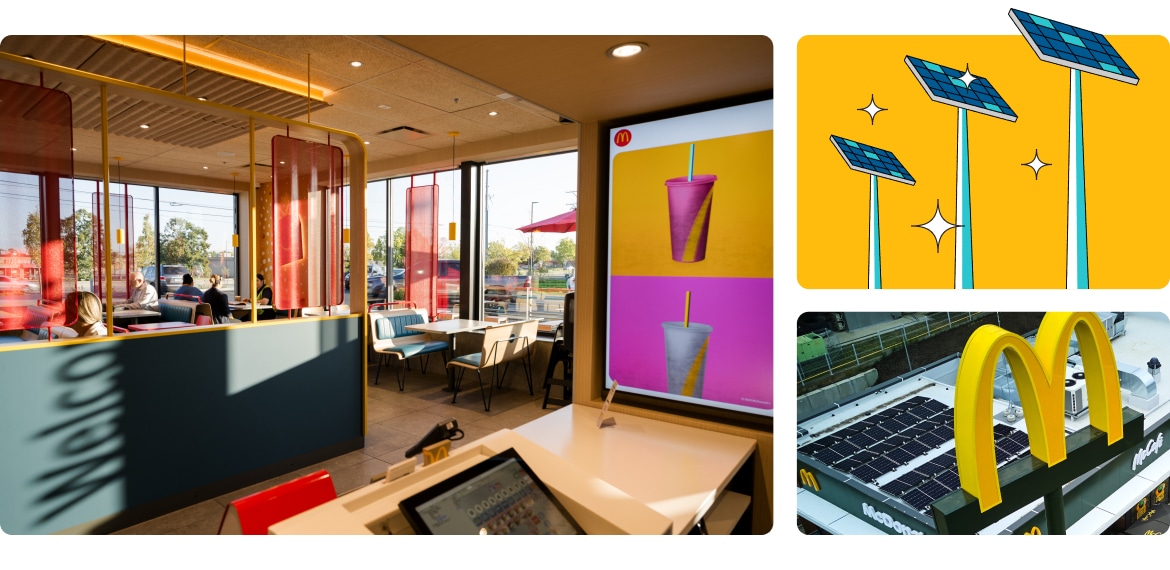
A McDonald’s developmental licensee increased its restaurants with on-site solar by nearly one-third in 2025, reaching 44 restaurants
McDonald’s developmental licensee that operates restaurants across Estonia, Greece, Latvia, Lithuania, Malta and Romania has a steadfast focus on upping their use of clean energy. In 2025, they increased the number of their restaurants with solar energy sources on-site by nearly a third, jumping to 44 restaurants versus 30 in 2024.

China
Built-In Carbon Capture
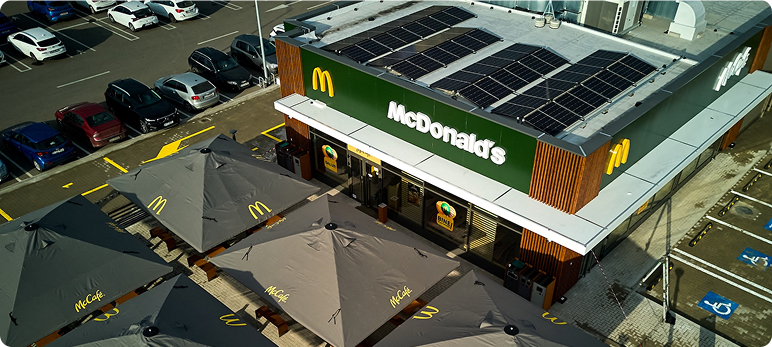
40 restaurants in China built with carbon-capturing bricks, collectively storing 22.14 metric tons of carbon
McDonald’s China has scaled a breakthrough brick technology designed to capture carbon through purified tail gas. In 2024, McDonald’s China trialed carbon capture, use and storage (CCUS) bricks at one of their restaurants in Shenzhen; in 2025, they rolled out the use of CCUS bricks further across Zhejiang province. As of the end of 2025, 40 restaurants in China feature CCUS bricks, collectively storing over 22.14 metric tons of carbon.

Latin America
A Multi-Faceted Approach to Energy Use and Restaurant Builds
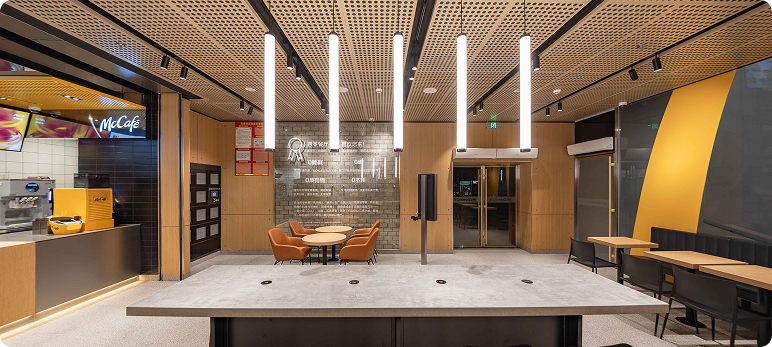
1,500 solar panels installed in Chile expected to generate energy equivalent to nearly 400 metric tons of carbon emissions from fossil fuel-based sources
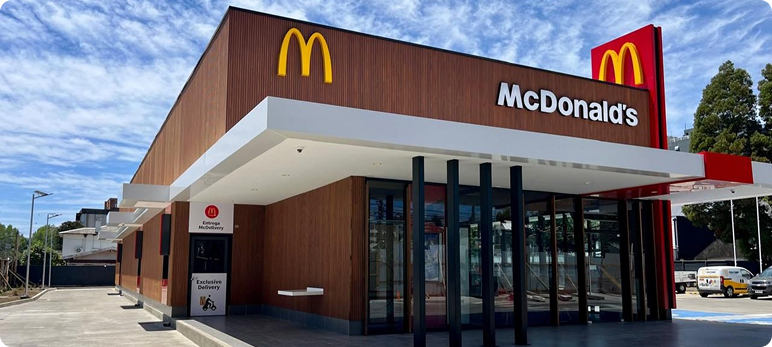
Arcos Dorados, a McDonald’s developmental licensee operating in Latin America and the Caribbean, achieved 50% clean energy use in its restaurants in 2025. In Chile alone, their installation of more than 1,500 solar panels in 2025 is expected to generate energy each year equivalent to nearly 400 metric tons of carbon emissions from fossil fuel-based power sources.
In 2025, Arcos Dorados also opened their first restaurant built with Forest Stewardship Council® (FSC®)- and Programme for the Endorsement of Forest Certification (PEFC)-certified wood, as well as solar water heaters.
The Netherlands
Switching Things Up for a More Sustainable Restaurant
Sustainability at the forefront of Dutch restaurant upgrades
A restaurant in Eindhoven was overhauled in 2025 with sustainability features front of mind. It has been fitted with waterless urinals as well as hand-drying faucets designed to save water and electricity. The refreshed space also features materials selected with consideration for circularity, like floor tiles with Cradle to Cradle Certified® credentials.
These changes complement other sustainability-related upgrades already implemented, including a new HVAC system that incorporates heat pumps that use ambient energy sources and may reduce reliance on conventional fossil fuel‑based heating.
Footnotes
1 Our definition of “clean energy” matches the GHGP definition of “green power,” which is: A generic term for renewable energy sources and specific clean energy technologies that emit fewer GHG emissions relative to other sources of energy that supply the electric grid. Includes solar photovoltaic panels, solar thermal energy, geothermal energy, landfill gas, low-impact hydropower and wind turbines.
See all the stories related to our 2025 Purpose & Impact Report

Read more about our 2025 progress in our 2025 Purpose & Impact Report