The Happy Meal® Through the Ages: Evolving the Nutritional Profile of Our Offering
December 31, 2025
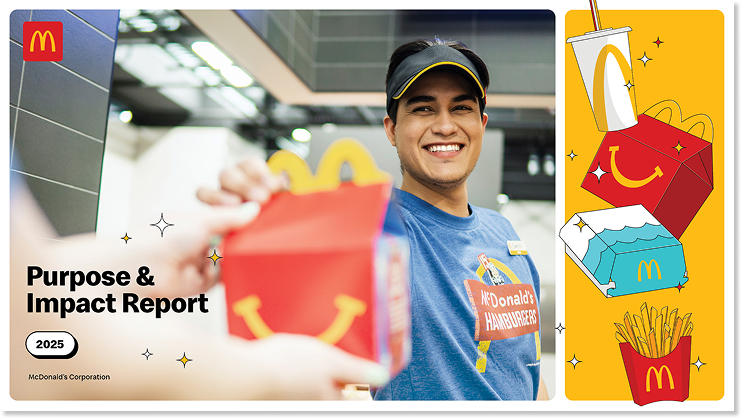
The McDonald’s Happy Meal®: an iconic feature of our menus since the 1970s. Loved around the globe, this offering has evolved over the years, as we strive to offer more balanced meals that parents can feel good about feeding to their children.
So where did the Happy Meal® start, and what does it look like today?


Happy Meal® Beginnings
It’s 1979, and McDonald’s has just launched the Happy Meal® in the U.S. Costing $1.10, the meal – which came in a circus-themed box – included a regular-size burger or cheeseburger, fries, a cookie sampler, a soda and a surprise toy.
And it was a success.
By the ’80s, the Happy Meal® had become a permanent fixture of U.S. menus, thanks, in no small part, to the addition of Chicken McNuggets® in 1984. We also began to expand the offering to new markets, starting with Latin America, Australia and New Zealand in 1982. By 1998, it was available in 40 different countries.

An Era of Evolution
As we approached the mid-2010s, parents were looking for more variety in Happy Meal® choices, so we took to the drawing board and started refreshing our winning formula. For example, in the U.S., we reduced the fries portion by more than half, introduced apple slices and brought in reduced-sugar, low-fat chocolate milk. We also removed soft drinks and cheeseburgers from menu boards.
In 2018, to continue building on this momentum, we introduced a series of Global Happy Meal® Goals. With a target year of 2022, these goals were designed to drive progress on offering balanced meals, maintaining simplified ingredients, being transparent about nutrition information, marketing responsibly and leveraging innovative marketing to boost purchases of items with recommended food groups.
And they had an impact. More than 5.7 billion Happy Meal® offerings sold from 2018 to 2022 in our 20 major markets1 contained recommended food groups (fruits, vegetables, low-fat dairy, water, lean protein or whole grain). What’s more, we’ve removed 100% of artificial flavors, added colors from artificial sources and – where feasible2 – artificial preservatives from our Happy Meal® offerings as of 2022. It’s an achievement we’ve sustained all the way through 2025 and across all 20 in-scope markets.


The Happy Meal® of Today
Since the conclusion of our Happy Meal® Goals, we have continued to track and report performance across our 20 major markets using our core measures, which remain influential in how we evolve the Happy Meal® over time.
Today’s Happy Meal® delivers the same joy and flavor with an enhanced nutritional profile. The default drink options are water, juice or milk. Fruits and/or vegetables are available as side options for every Happy Meal® – not just apples, but some markets offer choices like carrots, cucumbers, tomatoes, pineapple and melon too. In fact, across our 20 major markets, kids can pick from over 60 fruit and vegetable options.
And it doesn’t stop there. Since 2018, we have reduced the calories, saturated fat, sodium and added sugar content in our Happy Meal® offering.
Between 2018 and 2025, we’ve cut:
- Calories by 7%
- Saturated fat by 21%
- Sodium by 15%
- Added sugar by 35%
“The impressive results of this commitment prove that meaningful change is possible when you combine the global scale of a corporation like McDonald’s with the expertise of Alliance for a Healthier Generation. Around the world, millions of families have benefited from reduced calories, sodium, saturated fat and added sugars in Happy Meal® Bundles; dozens of new fruit and vegetable offerings; and more stringent requirements around nutrition information, artificial ingredients and advertising to children.”
Kathy Higgins, CEO, Alliance for a Healthier Generation
Across our 20 major markets, today’s Happy Meal®, on average, contains less than 440 calories and comes with over 60 fruits and vegetables to choose from
We’ve leaned into creative marketing to help make nutritious items more fun and appealing for families. From themed packaging to creative campaigns featuring fruits and vegetables, and fun food presentation – like crinkle-cut carrots in Austria – we’re working to make fruit and vegetable options fun for kids all around the world.


Footnotes
1 Our major markets include Argentina, Australia, Austria, Brazil, Canada, China, France, Germany, Hong Kong, Italy, Japan, Mexico, the Netherlands, Poland, Spain, Sweden, Switzerland, Taiwan, the U.K. and the U.S.
2 Our top priority is to ensure all items meet their strict food safety and quality standards. “Where feasible” means that by removing an artificial preservative, there will not be a sacrifice in the food quality or safety standards, value or taste. In certain cases, it was determined that an artificial preservative was necessary to ensure the safety, quality, taste or value of the food.
See all the stories related to our 2025 Purpose & Impact Report

Read more about our 2025 progress in our 2025 Purpose & Impact Report